Memo
What we're building & why
AI for finance has promised speed and intelligence for years.
In practice, fund teams still rely on fragmented spreadsheets, manual reconciliation, and repetitive reporting across funds, portfolios, and stakeholders.
There’s over $15 trillion in private capital globally, across private equity, credit, infrastructure, venture, and hedge funds (KKR, September 2024). Millions of analysts, fund accountants, and associates keep that machine running, checking waterfalls, updating memos, reconciling models, formatting LP reports.
Every week, countless hours are lost not to analysis, but to repetition.
Our thesis is simple: Finela doesn’t replace fund teams. It standardizes, augments, and scales them across the entire firm.
The next generation of firms will operate from a single intelligence layer across funds, portfolios, and functions with shared context, controls, and auditability.
Finela is not a general-purpose AI. It is a fund-native operating layer purpose-built for regulated, multi-asset class environments.
Our goals are clear:
Equip entire firm with AI that understands firm-specific logic across funds, vehicles, portfolios, and reporting structures.
Give every firm a private, role-aware AI workspace shared across teams, with permissions, audit trails, and zero data leakage.
"text-to-spreadsheet" is solved.
"clarity" still isn’t solved.
"text-to-spreadsheet" is solved
We define "text-to-spreadsheet" as the ability to create a complete financial model or dashboard from a plain-language request, when all context is already known.
By that definition, text-to-spreadsheet is mostly solved.
Today’s LLMs can already build working sheets from a single prompt.
They can generate formulas, link assumptions, even build charts that make sense.
Tools like Copilot, Gemini, Claude, and several open-source frameworks already do this reliably.
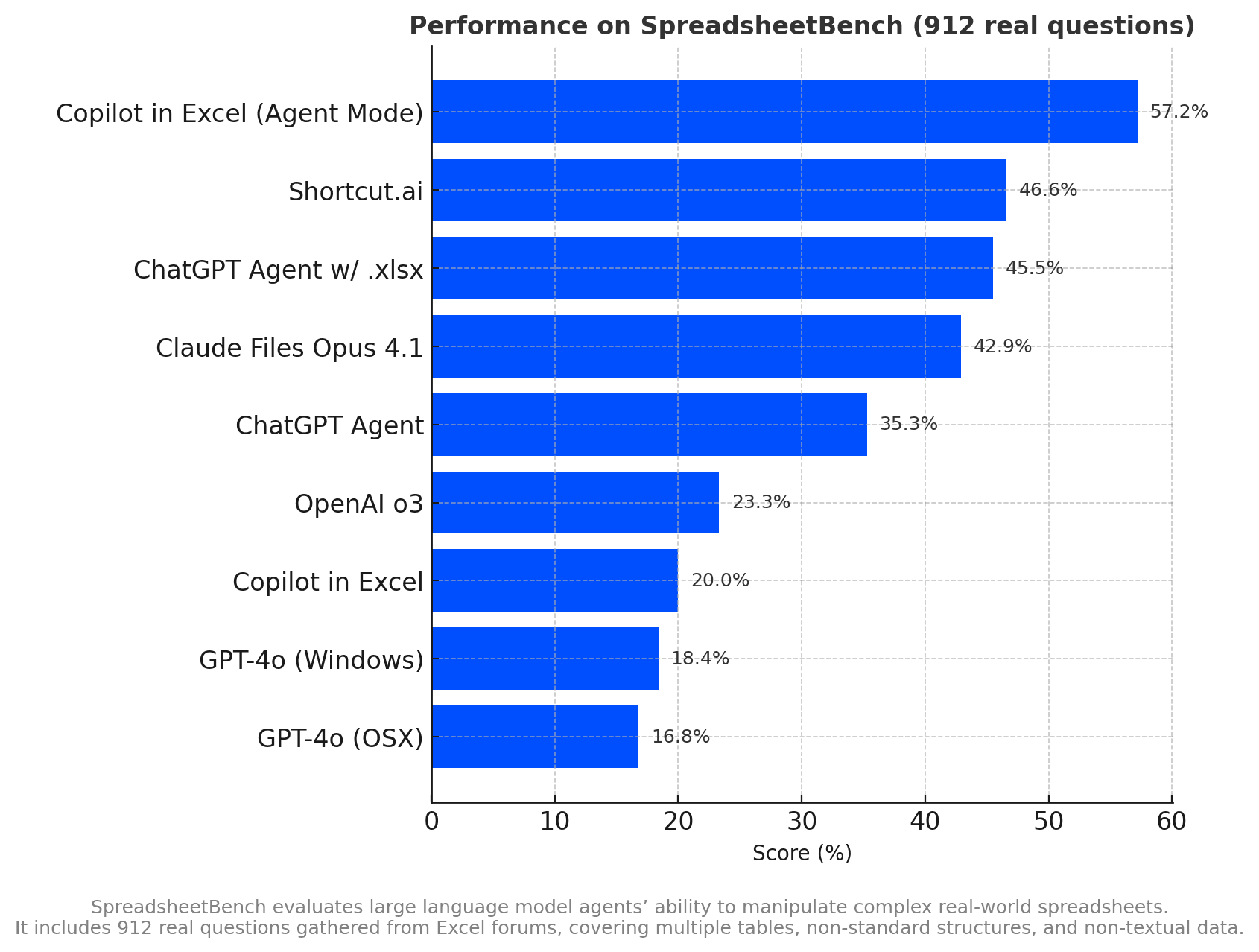
To prove the point, we often show the Spreadsheet-Eval benchmark (September 2025) — which measures how well leading models handle spreadsheet creation and logic in real-world fund scenarios.
Top agents, like Copilot in Excel (Agent Mode), already score above 57%, with others close behind.
The math is fine.
The automation is fine.
But that only works when everything is perfectly defined, when every metric, sheet, and source is crystal clear.
"clarity" still isn’t solved
At scale, clarity breaks not at the analyst level, but at the firm level. If text-to-spreadsheet is solved, why are fund teams still spending hours reconciling models, fixing assumptions, and reviewing the same reports?
The issue isn’t the sheet.
It’s the story behind it.
Imagine hiring a brilliant fund analyst who knows every Excel trick in the book.
On day one, you hand them your models, LP letters, and deal memos, then cut them off from the rest of the team.
Will they make perfect calls on every portfolio metric, capital call, and distribution?
No chance.
They’ll spend weeks guessing what each tab or formula really means.
AI today faces the same challenge.
It can calculate, but it can’t understand your firm’s logic, definitions, or hidden assumptions.
Finela is built for that gap.
It doesn’t just calculate, it understands.
It understands how your firm works, preserves institutional knowledge, and scales decision-making across the entire organization securely. Finela isn’t another productivity tool. It’s how the next generation of fund teams will think, decide, and operate.
What if all your data worked together?
Private deployment. Enterprise-grade security. Your data stays yours.