Executive Summary
The gap between data and understanding is becoming the defining constraint in private markets.
The industry has invested heavily in systems of record. What it has failed to build is a system of understanding, and the cost of that gap is accelerating.
Global private capital AUM has grown from roughly $4 trillion in 2010 to over $13 trillion by end of 2024. The operational infrastructure supporting this capital has not kept pace. The challenge is no longer about accessing capital or sourcing deals. It is about the internal machinery that processes, interprets, and communicates what is happening across increasingly complex fund structures.
This report is written for the five executives who feel this most acutely: the COO managing the invisible operating layer, the CFO responsible for audit-ready reporting, the CIO whose team waits on data rather than acts on it, the Managing Partner whose deal pipeline depends on operational credibility, and the Head of IR navigating LP expectations that have never been more demanding.
"We have the data, but it still takes too long to understand what is actually going on."
Persistent theme across CFO, COO, and investment leadership conversations, 2025 to 2026
The convergence of three forces, namely structural complexity, rising regulatory pressure, and a new generation of LP expectations, has created what we call The Operational Reckoning. Firms that treat operations as a cost centre will find themselves constrained. Firms that treat operational intelligence as strategic infrastructure will compound advantage.

Section 01
The Market Context
More capital, more complexity, and an operational infrastructure visibly struggling to keep pace.
The past decade in private markets was defined by scale. Flagship funds grew larger. Strategies multiplied across buyout, growth equity, private credit, secondaries, and real assets. Co-investment vehicles, continuation funds, and GP-led secondaries added further structural layers. In parallel, fund administrators, accounting platforms, and portfolio management tools became deeply embedded across operating models.
Yet despite this investment in infrastructure, a persistent theme has emerged. As firms scale, institutional friction increasingly shifts from transaction processing to interpretation, explanation, and coordination. The constraint is no longer access to information. It is the ability to reason across fragmented information at speed and with confidence.
Three structural forces are now converging:
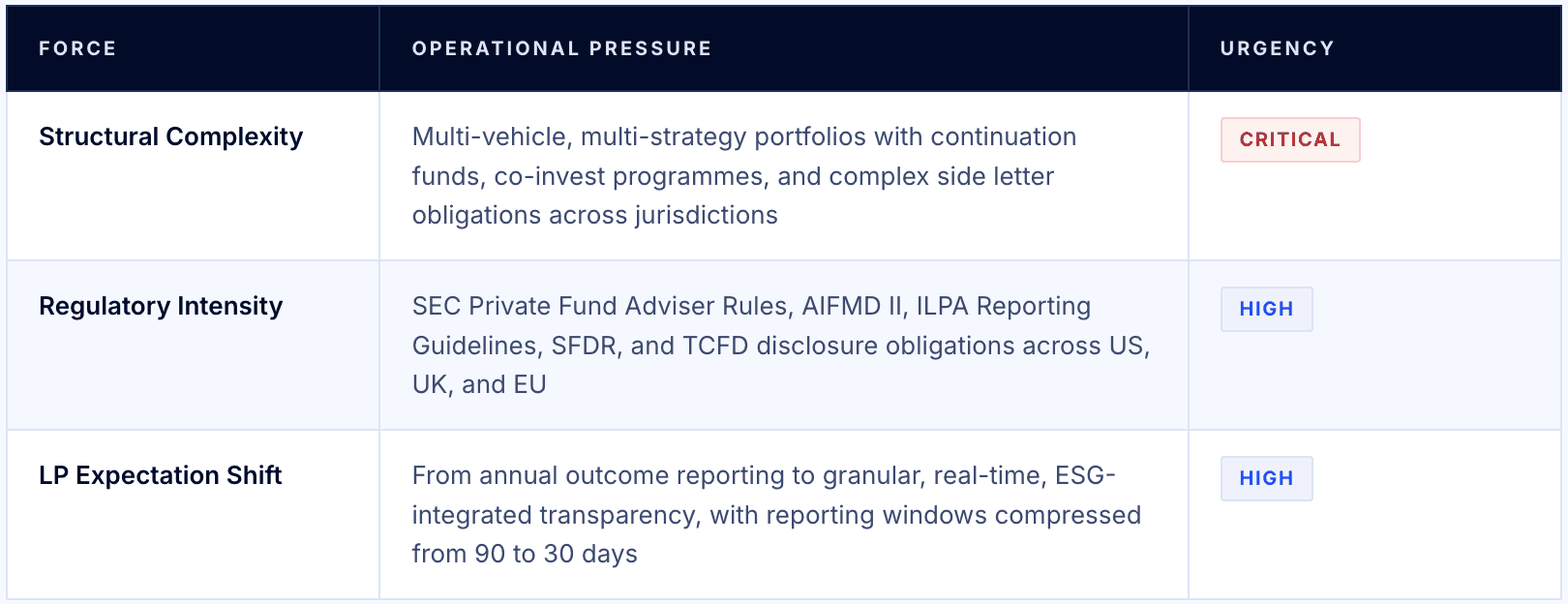
The scale paradox: as capital, complexity, and tooling increase, institutional understanding becomes harder to maintain. Systems were designed to scale volume, not context and reasoning.
Section 02
Five Pressing Challenges, by Role
Each leadership function faces a distinct version of the same underlying problem. Here is what it looks like at ground level.

Ask most operations leaders where processes live and they will point to systems. Ask their teams and the honest answer is: inboxes and spreadsheets. The most critical operational reasoning, covering the interpretation of capital flows, translation of side letters, and reconciliation of NAV discrepancies, sits in an informal layer that is undocumented, person-dependent, and non-version-controlled.
This invisible operating layer scales poorly. According to PwC's AWM Operations Survey, audit-related internal hours have increased approximately 25 to 35% over five years, driven not by increased fund count alone, but by fragmented logic that cannot be quickly verified or defended.
The Waterfall Problem
Distribution waterfalls are where spreadsheet fragility is most acute. Approximately 70% of mid-market firms manually adjust waterfall logic at least once per fund lifecycle. Around 40% maintain shadow carry projections in parallel. A 0.5% misallocation on a $300m distribution equals $1.5m of economic distortion, compounded by the absence of any single authoritative logic source.

COO Diagnostic Questions
How many hours per quarter does your team spend on reconciliation and variance explanation rather than producing decisions?
Where does distribution waterfall logic live, and who is the single point of failure?
If your most experienced analyst left tomorrow, what institutional knowledge walks out the door?
Can your operations scale by one vehicle without hiring 0.6–0.8 additional FTE?
How many versions of waterfall logic currently exist across your vehicle portfolio?

The CFO role in private markets has expanded from fund accounting steward to enterprise risk owner. In 2026, they are simultaneously managing audit intensity, LP reporting obligations, regulatory compliance, and distribution accuracy, with teams that have not grown proportionally with fund complexity.
Finance teams frequently rebuild valuation logic each quarter, extracting portfolio data, updating comparables, reconciling FX and debt positions, and recomputing IRR, rather than working from a continuously reconciled base. According to EY's Global PE Reporting Survey, approximately 50% of firms rebuild valuation models from scratch each quarter, and 10–15% adjust IRR calculations post-initial computation due to timing errors.
The Audit Exposure Problem
As regulatory oversight intensifies under SEC Private Fund Adviser Rules and AIFMD II, tolerance for audit ambiguity has narrowed. Approximately 20% of fund audit comments are now tied to valuation transparency, yet in most mid-market managers the logic behind valuations is reconstructed retrospectively. The CFO must defend outputs they cannot fully trace in real time.

CFO Diagnostic Questions
How many hours does your team spend re-explaining numbers rather than producing them?
Does your valuation logic exist as an auditable trail, or is it reconstructed each quarter?
Can you produce LP-ready reports for each vehicle within 48 hours of quarter close?
Are your capital call and distribution processes fully defensible under current regulatory scrutiny?
How long would it take your team to respond to an unannounced regulatory examination today?

Investment teams have never had access to more data. Portfolio management platforms, market data subscriptions, and administrator reports generate enormous volumes. Yet CIOs across the mid-market consistently report decision-making constrained not by the absence of data but by the absence of timely, reconciled, and interpretable data.
IC preparations consume disproportionate resource on data assembly rather than insight generation. Portfolio monitoring lags by days or weeks. Variance explanations require ad hoc analysis rather than surfacing automatically. The result is a structural gap between the accuracy delivered by systems and the understanding manufactured manually by a small number of people who carry institutional memory.
The Key-Person Intelligence Risk
When the analyst who owns the portfolio tracker or the VP who carries the mental model of a complex holding leaves, the intelligence gap widens overnight. Monitoring capabilities that appeared robust become fragile. This is not a talent problem. It is an architectural one.
CIO Diagnostic Questions
How many business days does it take to answer: which portfolio companies have underperformed against underwriting metrics?
Where does your team spend more time, assembling data or acting on it?
What happens to your monitoring capability when a key analyst or VP leaves?
Can you produce an IC-ready portfolio update in under 24 hours from a standing start?
How confident are you that internal portfolio views and administrator reports are reconciled in real time?

Managing Partners increasingly recognise that deal quality alone no longer differentiates a fund. LP conversations in 2025 and 2026 have shifted materially toward operational credibility, specifically the ability to demonstrate not just what returns have been, but how the firm manages, monitors, and governs its portfolio.
GPs raising Fund III or Fund IV are competing against managers who offer sophisticated reporting, real-time LP portals, and ESG-integrated performance narratives. Institutional LPs now run their own operational due diligence processes, asking about data infrastructure, key-person risk, and reporting architecture before committing capital.
The Deal Flow Dimension
For deal teams, operational friction has a direct cost. Diligence processes that depend on manual data extraction slow execution. Portfolio monitoring that relies on ad hoc analyst work limits coverage scale. With value creation increasingly depending on operational improvement rather than financial engineering, the quality of portfolio intelligence available to deal teams has never mattered more.
Managing Partner Diagnostic Questions
Can your operations team demonstrate real-time portfolio performance to an LP on 24 hours' notice?
What does your current operational infrastructure signal to an LP conducting operational due diligence?
How quickly can your deal team access comparable portfolio metrics when evaluating a new investment?
Is your operational infrastructure ready to support the next fund raise and withstand LP scrutiny?
What is the opportunity cost of deal execution time lost to manual data assembly?

Investor Relations has undergone a fundamental transformation. The function that once managed calendars, drafted quarterly letters, and coordinated annual meetings is now the interface between a firm's operational intelligence, or lack of it, and an increasingly demanding LP community.
LP expectations have shifted across three intersecting dimensions: transparency (granular fund performance data and clear return attribution), ESG integration (structured SFDR and TCFD reporting embedded in fund communications), and speed (reporting cycles compressed from 60–90 days to 30 days or fewer by LP demand). Most IR functions operate at the mercy of back-office reporting infrastructure, which is rarely built with IR responsiveness in mind.
The Fundraising Differentiator
In a fundraising environment where first and second closes are intensely competitive, the ability to respond to LP queries within hours rather than days, which is a material differentiator. Heads of IR are increasingly recognising that their commercial effectiveness is structurally limited by the operational architecture they inherit.
Head of IR Diagnostic Questions
How long after quarter-end can your team produce accurate, LP-facing performance reporting?
How do you currently handle bespoke LP data requests, and how long does each one take?
Is your ESG reporting structured and auditable, or narrative and retrospective?
What would happen to your LP relationships if your key reporting analyst left?
How are you managing LP portal access and data freshness across your vehicle portfolio?
Section 03
The Operational Intelligence Diagnostic
Understanding the challenge is one thing. Knowing exactly where your firm sits, and what to prioritise, is another.
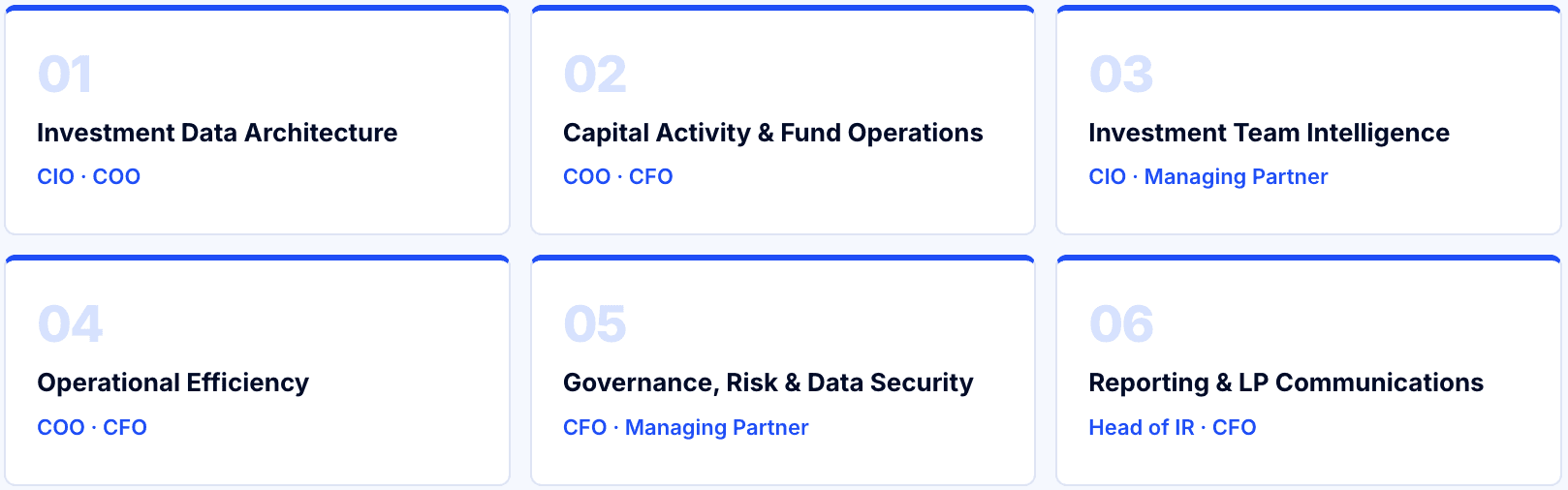
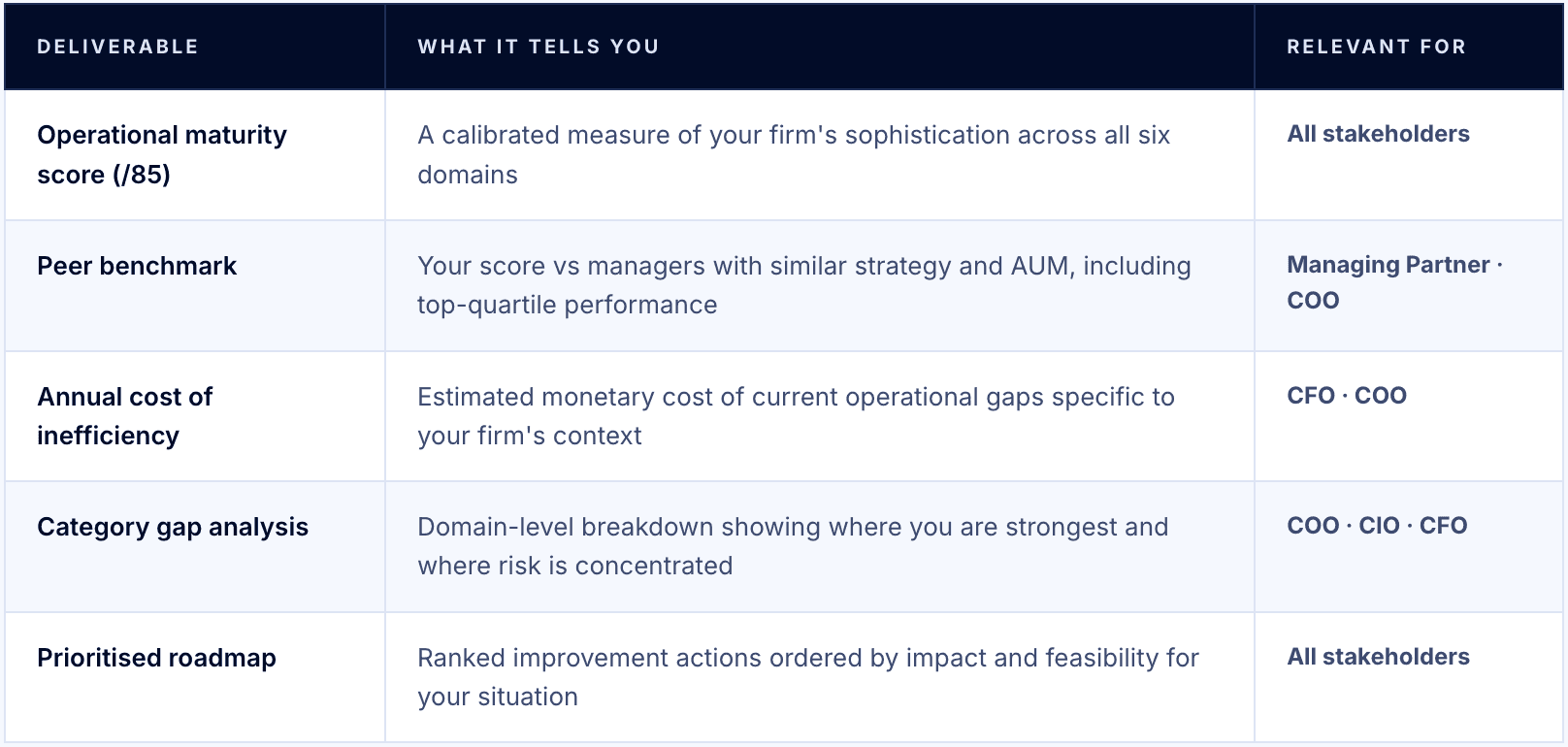
Finela's Operational Intelligence Diagnostic is a structured, peer-benchmarked assessment built exclusively for private market managers. 21 questions. Six operational domains. Approximately three minutes to complete. The output is a calibrated view of your firm's operational maturity benchmarked against comparable managers by strategy and AUM, with a prioritised improvement roadmap.

Six domains assessed
Your report includes
Section 04
The Finela Approach
Operational intelligence as infrastructure, not as an analyst capability or a reporting feature.
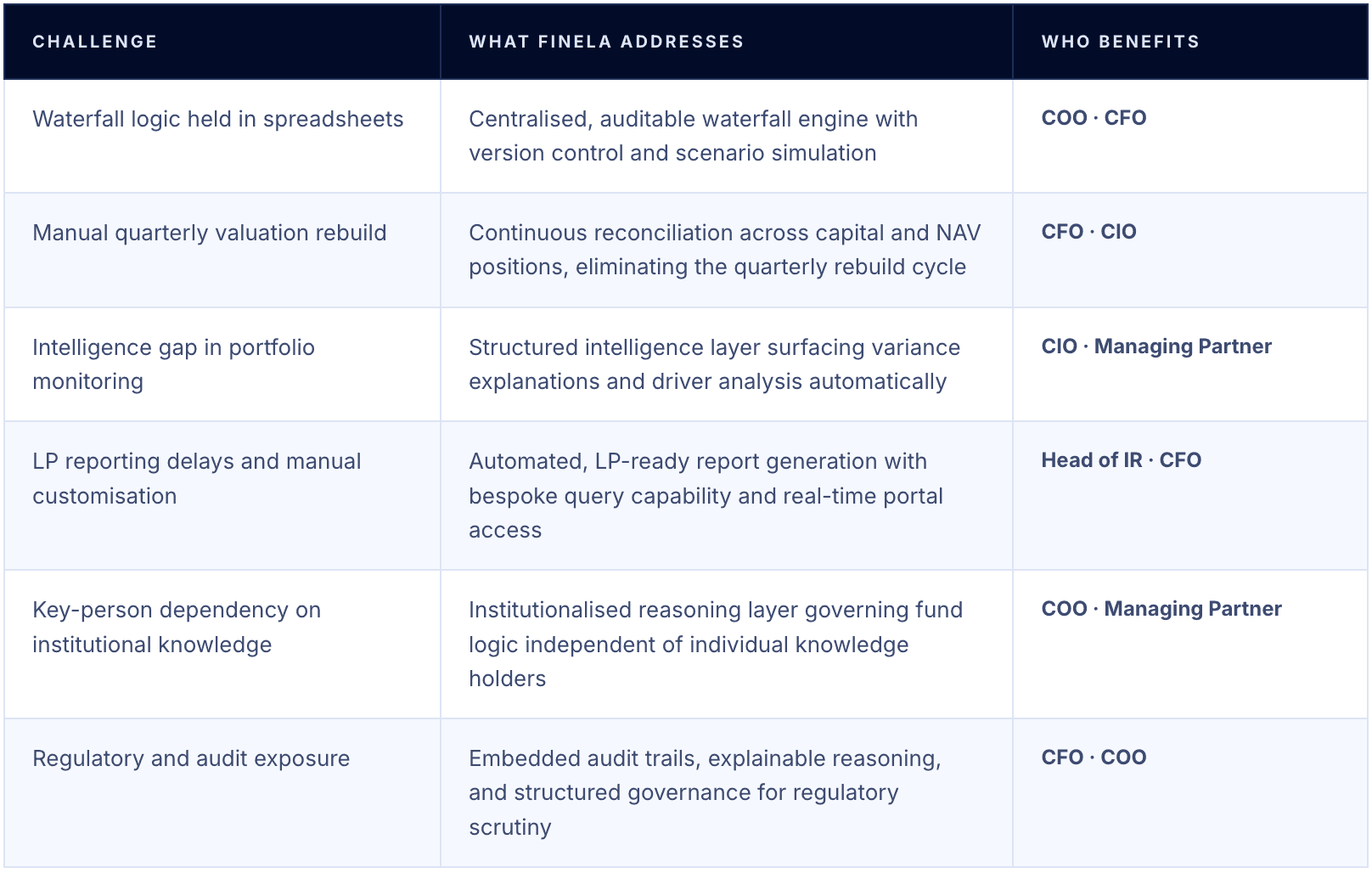
Finela operates as the AI operating layer for private markets and alternatives. Rather than replacing fund administrators, accounting systems, or portfolio management platforms, Finela addresses the layer that existing systems cannot: the interpretation, reasoning, and coordination layer that sits between them.
Private markets firms have invested significantly in systems of record. What they lack is a system of understanding: a layer that connects fragmented data into decision-grade intelligence, embeds operational reasoning so it is no longer person-dependent, and surfaces the right information to the right stakeholder at the right time.
What Finela addresses, by challenge
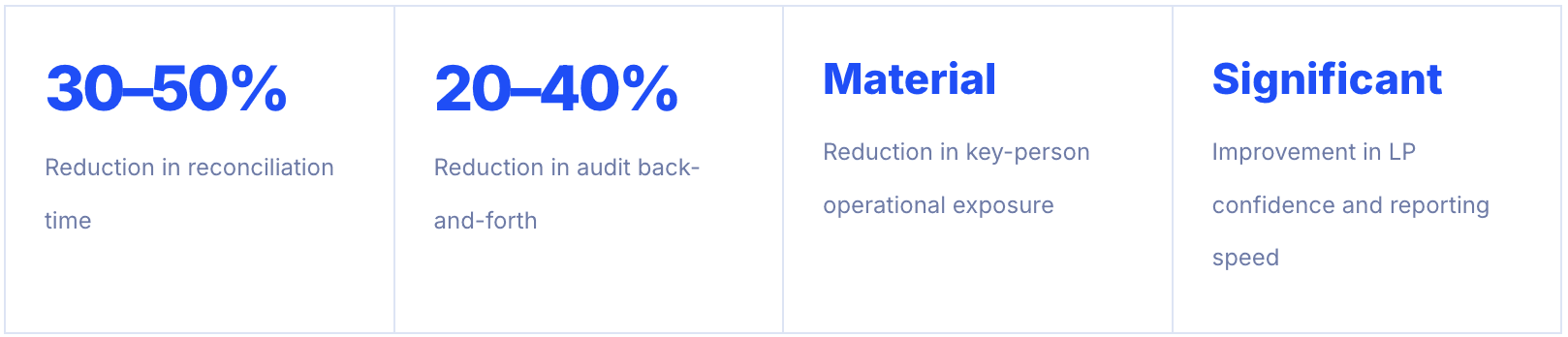
Observed impact across early deployments
Finela integrates with existing infrastructure, including SS&C, Apex, and Gen II fund administrators, eFront, Allvue, and iLEVEL portfolio platforms, and core accounting systems. Private deployment and enterprise-grade security ensure data sovereignty throughout.
Section 05
Actionable Roadmap
What to do next, by stakeholder. Operational transformation begins with clarity.
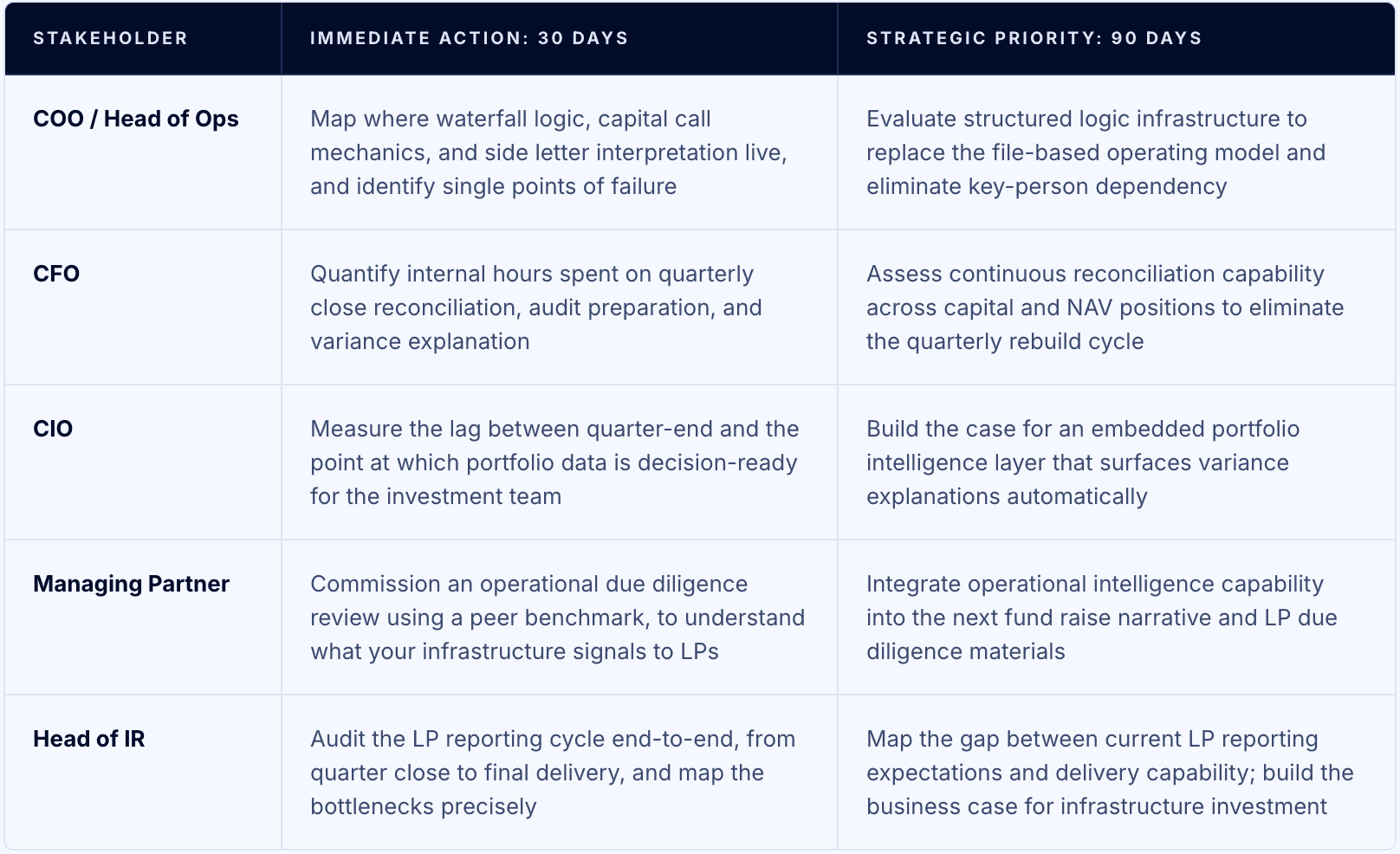
The single most valuable first step for every stakeholder is a calibrated, peer-benchmarked view of where your firm stands, and what the annual cost of current inefficiency is in your specific context.
Start Here
Complete the Operational Intelligence Diagnostic: finela.ai/diagnostics
Read: The Spreadsheet Operating Model is Breaking Private Markets, at finela.ai/insights
Read: The Intelligence Gap in Private Markets, at finela.ai/insights
Book a conversation with the Finela team: finela.ai/talk-to-us
Closing Perspective
The firms that will lead are being built now.
On operational intelligence, not operational improvisation.
The operational reckoning in private markets is not a future risk. It is a present reality. Firms competing for the same LP capital, the same deal flow, and the same talent in 2026 are increasingly differentiated not by strategy or track record alone, but by the intelligence of their operations.
The firms that build operational intelligence as infrastructure, rather than as an analyst capability, will compound advantage in ways that are difficult for competitors to replicate quickly. Those that continue to manage complexity through spreadsheets, institutional memory, and manual reasoning will find scale increasingly costly, audit increasingly fraught, and LP confidence increasingly fragile.
The question is not whether to act. It is how clearly and quickly leadership can see where to start.
"Tomorrow's fund leaders are being built today, on operational intelligence, not operational improvisation."