Executive Summary
Ask LPs how they feel about private markets and the surveys say they're fine — roughly 70% plan to maintain or increase allocations. Ask what they've actually done this year and the picture shifts: one in three US public pension funds cut private equity targets in 2025 alone, and family offices have taken private equity from 22% of portfolios down to a planned 17% in three years.
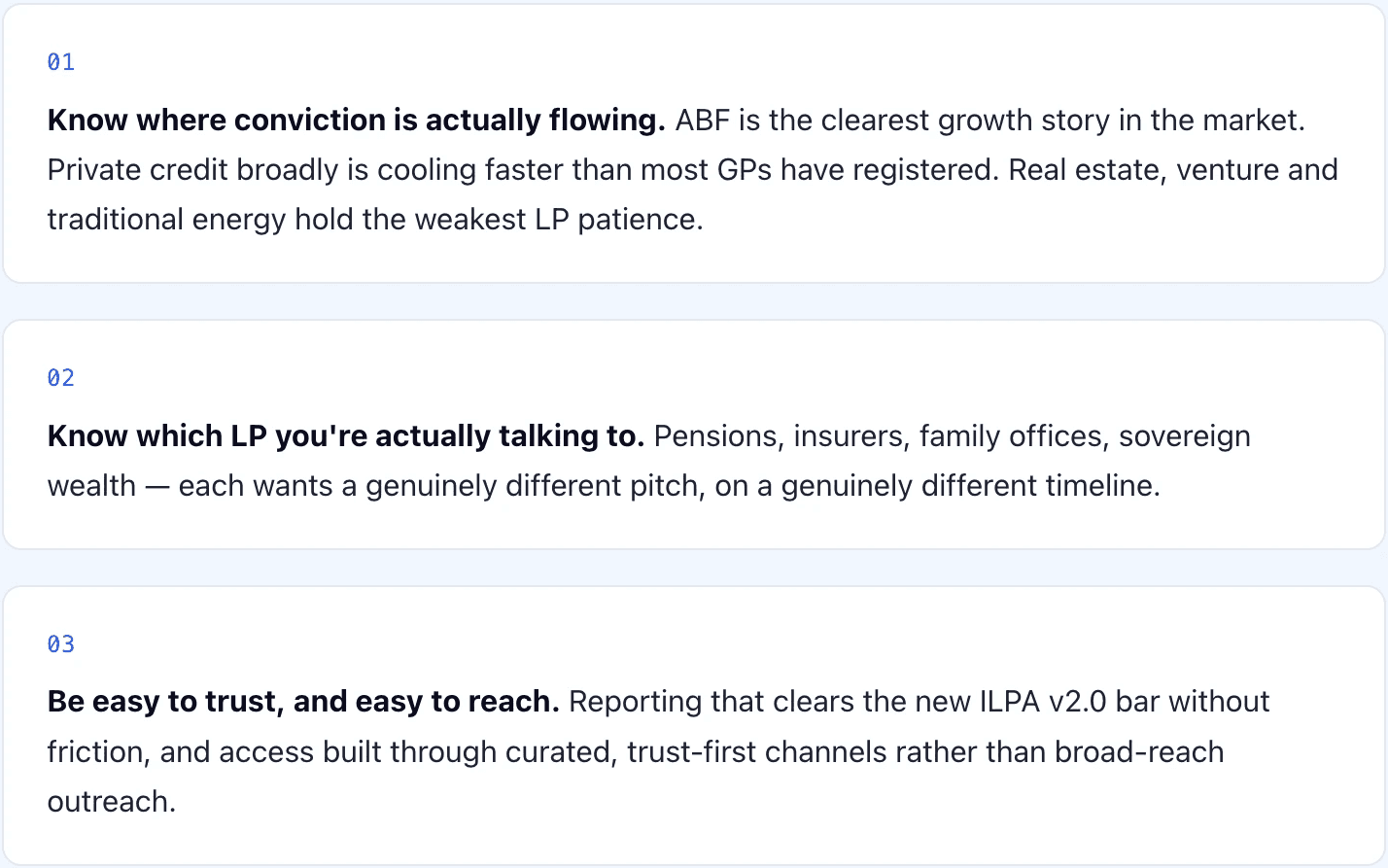
Both are true, and the reason is the same in each case. LP conviction in private markets hasn't disappeared. It's consolidating into fewer GP relationships, and moving hard toward specific strategies — asset-based finance, secondaries, co-investment — while pulling back from others.
Section 1
The Sentiment Paradox
Two surveys walk into a room
Ask LPs how they feel about private markets right now, and the numbers say they're fine. McKinsey's 2026 Global Private Markets Report puts roughly 70% of surveyed LPs in the maintain-or-increase camp. Preqin's own investor base tells a similar story: near-majority intent to increase allocations long term, and 81% planning to hold or grow private credit exposure specifically over the next year.
Ask a US public pension board what it actually did this year, and you get a different answer.
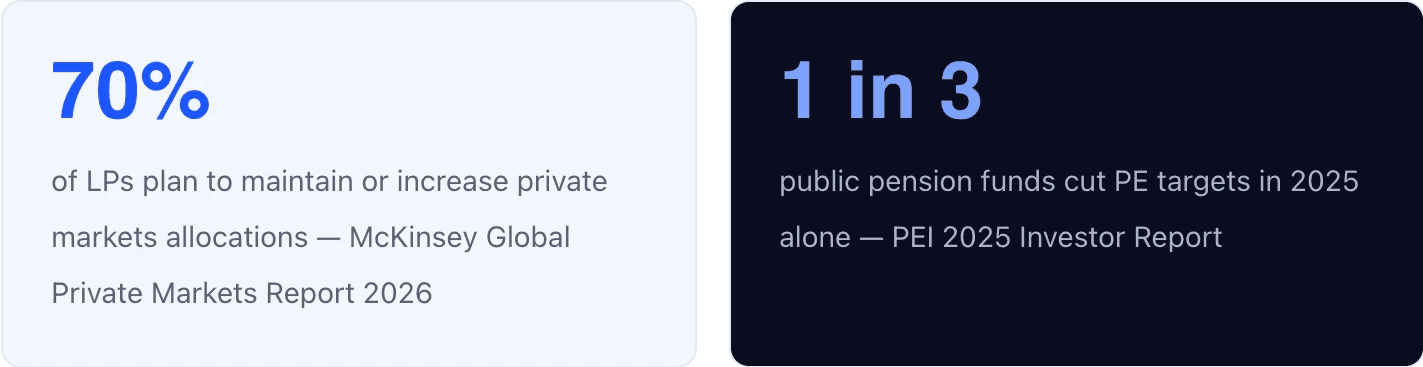
Oregon PERS has trimmed private equity from 27% to 25% of the portfolio, working toward a 20% target. Washington State's $185 billion fund cut its target from 25% to 23%. Alaska Permanent Fund staff recommended taking private equity from 18% to 15%. Virginia made its first private equity target cut in over fifteen years. New Jersey cut both private equity and real estate targets in the same board meeting.
Both things are true at once. That's the story worth telling, not either one on its own.
Why the average is hiding the real move
The reflex explanation is a "denominator effect" hangover. That's part of it. But Bain & Company's 2026 Global Private Equity Report puts a sharper name on what's actually happening: a K-shaped recovery. 2025 delivered real headline strength — near-record deal and exit values, the largest buyout in history at $56.6 billion for Electronic Arts. But that activity concentrated hard at the top, while distributions back to LPs kept disappointing across the rest of the market. Bain's Midyear 2026 update sharpens this further: an April 2026 ILPA poll found roughly one in five LPs are actively reducing buyout allocations, citing liquidity pressure and softer long-term return expectations.
23%of LPs now expect to reduce their number of GP relationships over the next three years, up from 16% when Coller Capital last asked in 2020. Headline conviction is intact. The way LPs express it is narrowing.
Put plainly: LPs aren't leaving private markets. They're leaving GPs.
The real question
So the useful question was never "are LPs bullish on private markets." It's "which GPs are LPs staying bullish on" — and increasingly, the answer comes down to two things: can this manager prove distribution discipline and reporting quality that survives comparison against twenty other funds in the same portfolio, and can this manager get in front of the right LP through a channel that signals fit rather than volume.
Section 2
Where the Conviction Is Actually Going
If Section 1's argument is that LP capital is concentrating rather than retreating, this section is where that concentration becomes visible strategy by strategy.
Direction | Strategy | Why |
|---|---|---|
↑ Rising | Asset-based finance | Projected to exceed $20tn over the coming decade as banks retrench from capital-intensive lending. Insurer and pension-led on capital-treatment logic. |
↑ Rising | Secondaries & continuation vehicles | 40% of LPs expect continuation vehicle activity to keep increasing even as exits improve — a permanent liquidity route, not a symptom of a broken exit market. |
↑ Rising | Co-investment | 88% of LPs intend to allocate up to 20% of portfolios to co-investment by 2030 — now a standard expectation, not a relationship perk. |
→ Cooling | Private credit, broadly | Share of LPs planning to increase fell from 42% to 29% in one six-month cycle. Selectivity is replacing broad-based deployment. |
↓ Weakest | Real estate / venture / energy | 21%, 20% and 21% of LPs respectively want to decrease exposure — the highest cut-intent of any strategies surveyed (Bloomberg Intelligence 2026). |
What this means for positioning
Line your fund's current strategy up against this map honestly. If you're in ABF, secondaries or co-investment, the market is moving toward you. If you're in broad private credit, real estate, venture or energy, you need a specific, evidenced reason your fund sits outside the part of the category LPs are pulling back from — and it needs to show up early in your pitch.
Section 3
Know Your LP: Four Archetypes, Four Different Games
A corporate pension board and a single-family office are not running the same process, on the same timeline, screening for the same things. Treating them as one audience wastes the meetings you do get.
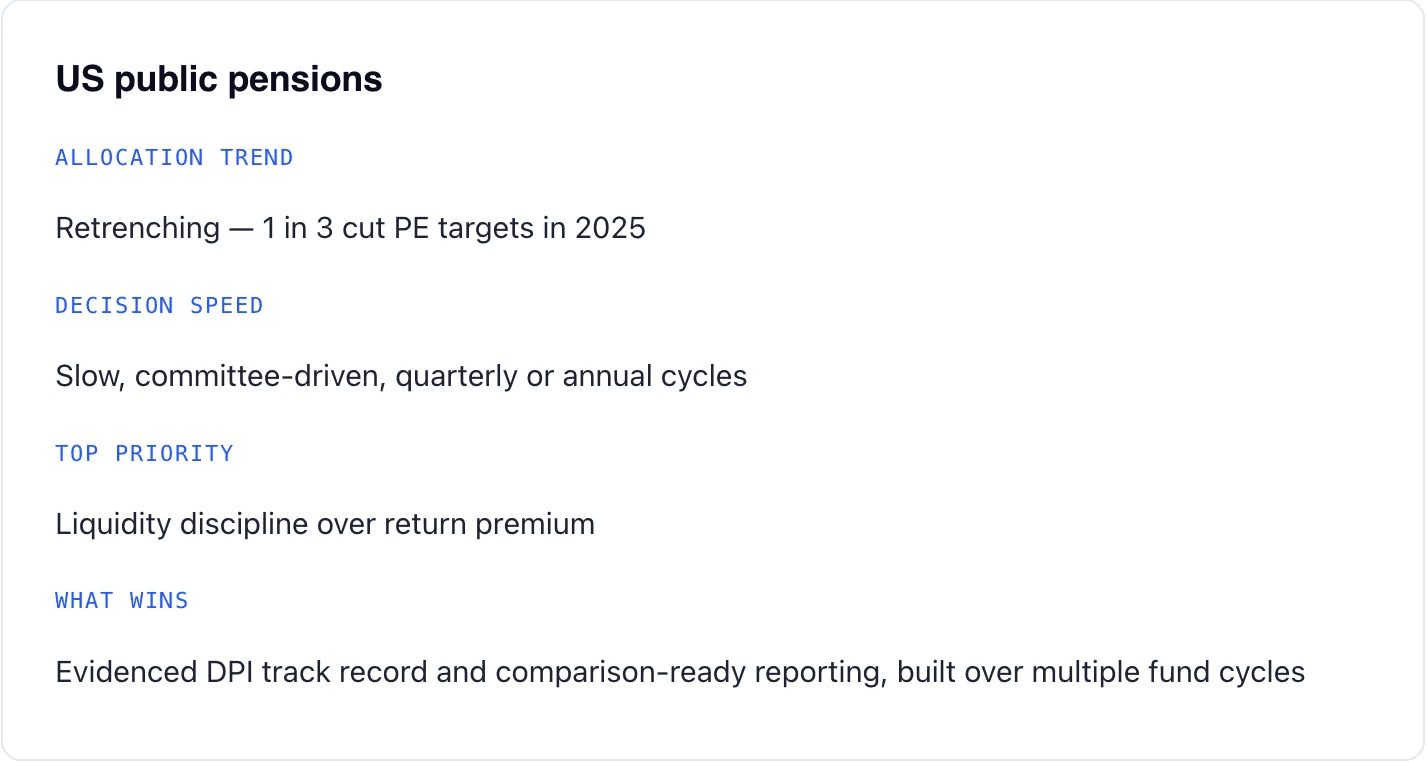
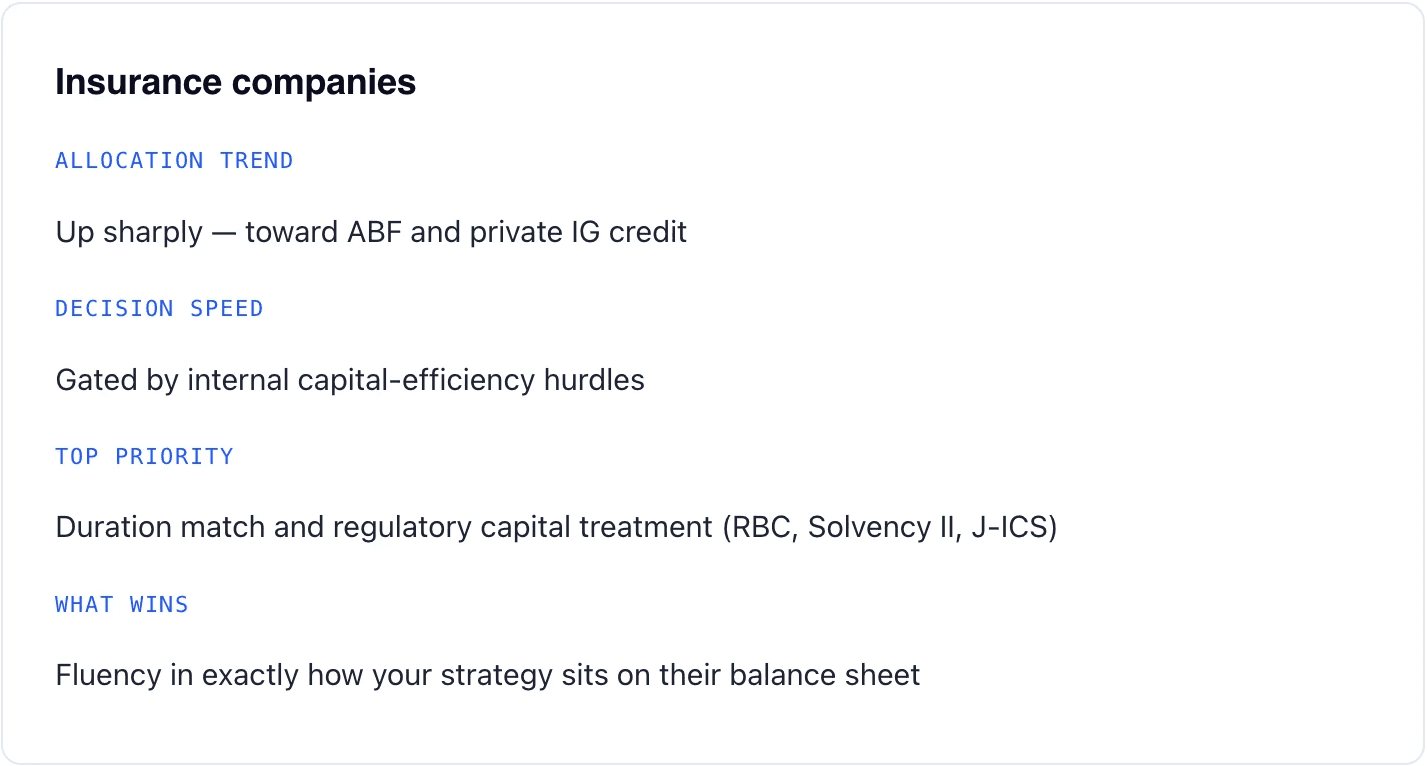

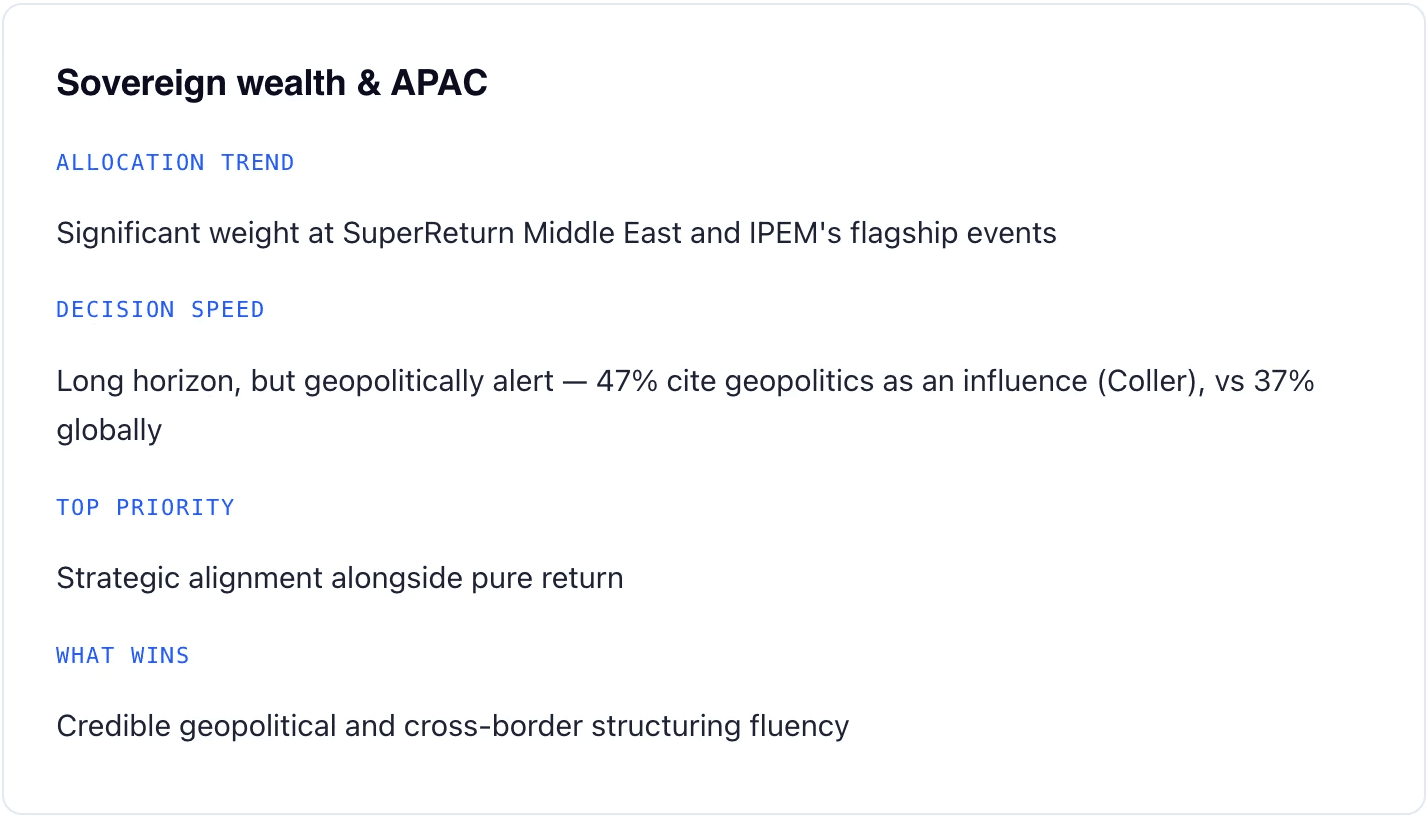
Before your next LP meeting, know which of these four is sitting across the table, and adjust the ask accordingly. The same fifteen-minute pitch will not do all four jobs.
Section 4
The Transparency Bar Just Moved
Every archetype in Section 3 wants something different from a GP relationship. There's one thing all four now expect in common, and most of the market hasn't caught up to it yet.
The biggest reporting overhaul in fifteen years
ILPA's Reporting Template v2.0 became effective for qualifying funds from Q1 2026 — the most significant structural revision since the original initiative launched in 2011. Three interlinked templates: a Capital Account Statement with an integrated Schedule of Fees, a Capital Call & Distribution Notice, and a standardised Performance Report covering IRR, TVPI and MOIC.
With the SEC's Private Funds Rule struck down, there's no federal reporting mandate filling the gap it left. LPs rallied around ILPA's template as the de facto standard by consensus rather than regulation — adoption now reads as a signal of a GP's professionalism, not a compliance box to tick.
Why this shows up in due diligence, not just in reporting
LPs holding twenty or more manager relationships need reporting they can actually compare across that portfolio. ILPA-format reporting is what makes that comparison possible. Quarterly reporting within 60 days of quarter-end is now the formalised expectation, in a market where annual reporting used to be acceptable to a meaningful share of LPs.
A GP whose reporting creates friction at exactly the moment an LP is deciding who makes the shortlist is handing that LP a reason to choose someone else. Operational maturity in reporting has become a visible stand-in for overall fund professionalism.

Section 5
Where Trust Actually Gets Built
Section 4 answered how a GP earns trust once an LP is already looking closely. This section is about the step before that: how a GP gets in front of the right LP in the first place.
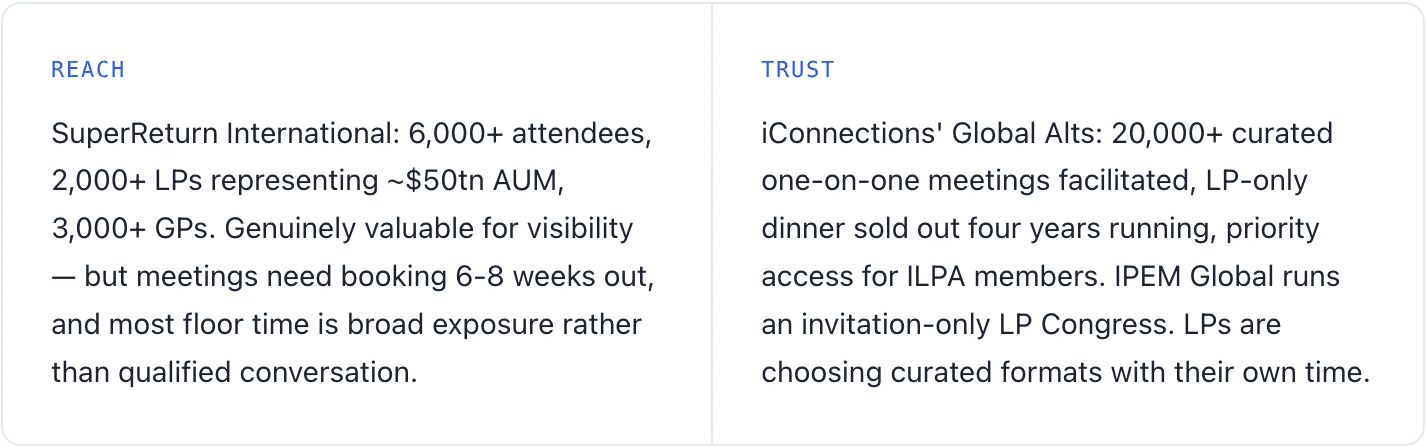
If an LP base is actively shrinking the number of new relationships it's willing to start, broad-reach outreach and mega-conference floor time become less efficient every year. The GPs winning first meetings with a narrowing pool of LPs are increasingly the ones getting there through access that's already been filtered for fit.
This is precisely the gap Finela is building toward on the access side of the relationship, alongside the reporting infrastructure covered in Section 4 — curated capital introduction built for exactly the kind of qualified, trust-first access this data shows LPs are already choosing for themselves.
Section 6
The IR/CIO Playbook
Five sections of data point toward one practical conclusion: LPs haven't left private markets, but they've narrowed who they trust with their capital. Here's what to do about it this quarter.
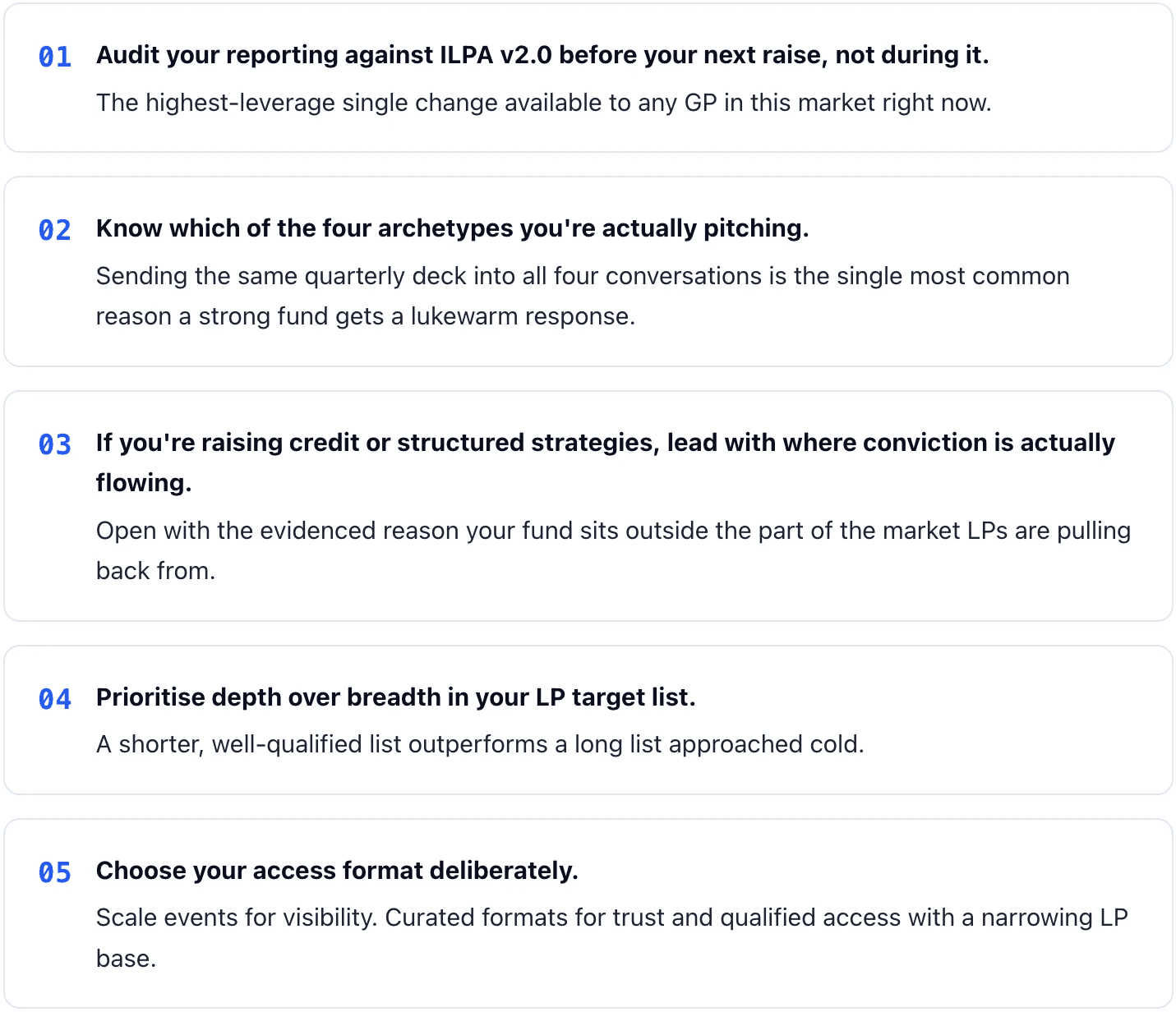
In a market where LP conviction is consolidating rather than disappearing, the GPs winning capital are the ones who are easiest to trust on paper and easiest to reach through channels LPs already trust
Appendix
Methodology & Sources
Methodology
This report draws on publicly available LP surveys, industry reports, conference programme materials, and market and legal commentary published primarily between late 2025 and mid-2026.
Sample sizes and fielding periods, where disclosed: PEI LP Perspectives 2026 (103 institutional LPs, Aug–Oct 2025); SS&C Intralinks/Reuters Events 2026 LP Survey (280 global LPs); Bloomberg Intelligence 2026 Private Markets Investor Survey (~102 LPs, Jan–Mar 2026); Coller Capital Global Private Capital Barometer, 44th edition (108 LPs, June 2026); UBS Global Family Office Report 2026 (307 family offices); Preqin Global Reports 2026 (435 institutional participants).
A small number of widely-circulated stats commonly attributed to Preqin — a transparency-importance figure, a reporting-frustration figure, an insurance fund-size threshold, and a GP re-up rate figure — could not be independently verified against Preqin's own published research during fact-checking and have been excluded from this version pending confirmation.
Conference calendar referenced
SuperReturn International — Berlin, June
SuperReturn regional/vertical editions — Private Credit (North America), Middle East, Emerging Markets, Venture
IPEM Wealth — Cannes, February
IPEM Global — Paris, September, with an invitation-only LP Congress
IPEM Future — Dubai, November
iConnections Global Alts — New York, Singapore/APAC
DealCatalyst Asset-Based Finance Conference — 4th edition
Full source list
McKinsey Global Private Markets Report 2026; Private Equity International LP Perspectives 2026 and 2025 Investor Report; SS&C Intralinks/Reuters Events 2026 LP Survey; Bloomberg Intelligence 2026 Private Markets Investor Survey; Preqin Investor Outlook H1 2026 and Global Reports 2026; Coller Capital Global Private Capital Barometer, 44th edition, Summer 2026; Bain & Company Global Private Equity Report 2026 (17th edition) and Midyear 2026 Report; UBS Global Family Office Report 2026; Campden Wealth/RBC and JPMorgan Private Bank family office data; DealCatalyst Asset-Based Finance Conference materials; Aviva Investors APAC insurer regulatory analysis; KKR "The Next Chapter for US Corporate Pension Plans"; Adams Street co-investment survey; ILPA Reporting Template v2.0 guidance; KPMG and industry legal commentary on the SEC Private Funds Rule vacatur; named public pension board reporting (Oregon PERS, Washington State Investment Board, Alaska Permanent Fund, Virginia Retirement System, New Jersey Pension Fund); SuperReturn International and regional programme materials; IPEM Wealth, Global and Future programme materials; iConnections/Global Alts event materials.